
Building a Ford Falcon XB GT: Restoring the Iconic Mad Max Muscle Car

Published the 11Th may 2026
vehicles
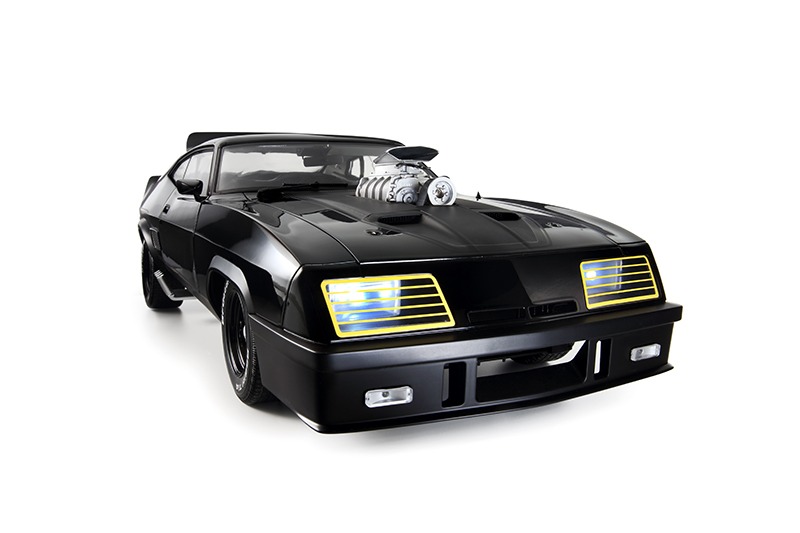
For over a year, mechanic Mark Simpson devoted every spare minute to a wildly ambitious project: building a customised 1973 Ford Falcon XB GT. The remarkable result would turn heads at car shows and be used as the basis for Hachette’s authentic 1:8 scale build-up model.
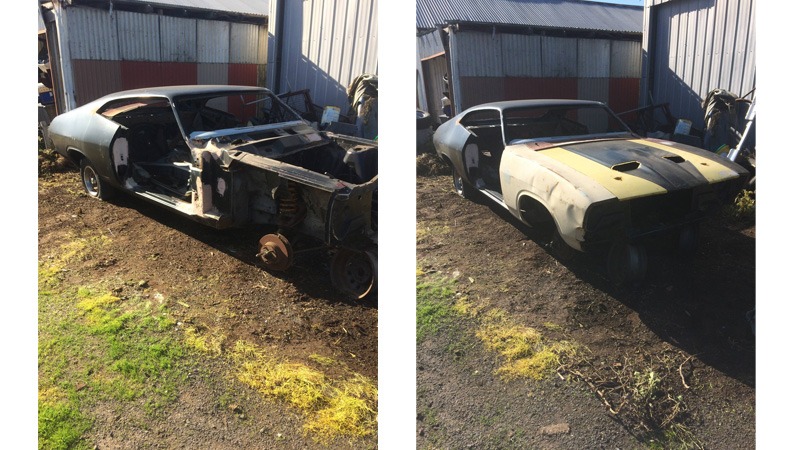
After 60 days at sea, the container finally arrived in Southampton Docks. For Mark Simpson – mechanic and classic car enthusiast – this was the moment he’d been dreaming of for six months, ever since he’d set himself the daunting challenge of building a customised 1973 Ford Falcon XB GT. Inside the container, he hoped, was the shell of the car – the first stage in what would be his most ambitious project yet.
Mark transported the container to his home in rural Somerset and, with a mixture of excitement and nervousness, examined what he’d bought, sight unseen. In many respects, the contents weren’t pretty. “It looked rough!” Mark laughs. “Just a pile of bits in cardboard boxes really. But I’d seen pictures and I knew what it was going to be like. The important thing was it was a solid car that I could work on.”
Mark was hardly a novice at building and restoring classic or custom cars: he’d already tackled a 1970 Dodge Charger, a 1915 Ford Model T and a DeLorean, as well as replicas of Knight Rider’s KITT and Starsky & Hutch’s Ford Gran Torino. But he’d never taken on anything quite like this: a customised version of a limited-edition, fifty-year-old car from the other side of the world. “I thought, ‘What have I done?’”, Mark says. He’s joking, of course: the fun lay in the challenge.
Global endeavour
The Ford Falcon XB is a classic piece of Australian automobile history. Racing icon Allan Moffat drove this model to victory several times in the 1970s, various iterations tore across the screen in Mad Max, Mad Max 2 and Mad Max: Fury Road, and Eric Bana even made an entire documentary on the subject in the form of 2009’s Love the Beast. The car made an impression on Mark at an early age when he glimpsed the Mad Max Pursuit Special at the NEC Motor Show during his teenage years (the car now resides at the Orlando Auto Museum).
However, the fact that it was an Australian classic car meant that many of the parts Mark needed were ten thousand miles away. The XB GT coup (or “hardtop” in Australian parlance) was a particularly challenging iteration as only 949 were ever made. Anyone who possessed one of these rare vehicles was extremely unlikely to want to part with its components.
Still, Mark got off to a good start. As well as the rusty shell, Mark’s contact in Australia – Cameron Manewell, who’d worked as an action-movie mechanic on Mad Max: Fury Road – managed to source the fibreglass body panels, distinctive flared arches and Arcadipane nose cone (complete with droopy, “Concorde style” air-dam). The latter, of course, was not on the original XB but a customised post-apocalypse modification; the part originated from a ute-style concept car known as the Ford Falcon XC Concorde Panel Van that had been spotted at a car show.
Attaching the nose proved to be an early challenge, albeit one the veteran mechanic was able to overcome. “It was quite hard to make it fit,” Mark recalls. “I had to fit a metal frame in behind it, and it was tricky to align all of that.”Once these initial parts were assembled, the first thing Mark did was strip it down and carry out essential welding work, before hiring a bodywork specialist that Mark had worked with to carry out the finishing, filler work and paintwork. What had been an unsightly hodgepodge of blacks, oranges and yellows was transformed into a faithful blend of gloss and satin blacks. Mark no longer had a wreck on his hands.
Taking shape
There were still some important elements missing from the car, however – not least the engine. “That was actually straightforward,” says Mark. “I found a 351 Cleveland engine on eBay from a Mustang in the UK, which is the same type. That was just a normal engine rebuild. Then the manual gearbox is from another Mustang from somewhere else [in the UK]. I just started putting it all together.”
The rear brakes were another component that came from the similar Ford Mustang Mach 1. “They’re exactly the same,” Mark says. “The 1970s Mustang and the Falcon were basically identical underneath. But I had to rebuild the front brakes, which are unique to Australia.”
Meanwhile, other parts from Australia kept coming, as Manewell and Mark’s other contacts gradually sourced them, including the suspension parts and, crucially, the wheels. “After that I put the tyres on,” Mark remembers. “They were Cooper Cobras, the same ones Cameron used on his car in Fury Road. My little tribute to him!”
While original parts from 1973 Ford Falcon XB GT were scarce, Mark did eventually manage to obtain an original fuel cap and dashboard gauges (“incredibly rare”). But elsewhere, he needed to widen his search to parts from similar vehicles that were scattered around the world.
Supercharged
There are notable differences between the original 1973 Ford Falcon XB GT and the post-apocalypse customised version – the aforementioned nose cone and flared arches, the roof and boot spoilers, the jacked-up rear (which Mark raised using leafspring adjusters). But there was another component that was absolutely essential to the post-apocalypse iteration – and it proved to be one of the trickiest parts to source.
We are, of course, talking about the Weiand 6-71 supercharger – the combustion engine that protrudes from the bonnet and gives the car an energy boost whenever the driver tugs a red lever attached to the gear stick (accompanied by an almighty sucking sound).
“I had to find parts for it that were made in the 1970s to make it look just right,” says Mark. “In the end, I managed to get the supercharger body from a company in California, as well as the Scott Super Slot injection unit that goes on top.”
The parts for the supercharger proved to be a globe-spanning endeavour, with the Weiand pulleys and belt adjuster coming from a man in Canada that Mark had connected with through Facebook. The result looks awesome – but it’s not quite as powerful as it looks. “The casing and intake is real, but it’s not a real supercharger!” Mark laughs. “It doesn’t function. I wanted it to be more like a prop. The pulley system is powered by a radio-controlled helicopter starter motor!”
And where did that red lever on the gearstick come from? “Oh that’s from Amazon,” Mark reveals. “They still make that – it’s an electronic gear changer from a lorry in America. That was probably the easiest part to find.”
Interior design
While obtaining the red lever may have been as simple as dropping it into an online shopping basket and pressing “Buy Now”, a little more work went into sourcing the rest of the car’s effortlessly cool interiors. Finding parts that would closely match the original was no mean feat, but Mark managed to track down brand-new black vinyl seat covers, carpet, roof lining and dash from other iterations of the Falcon, as well as a vintage Maxrob steering wheel (a desirable addition to Australian muscle cars in the 1970s).
As well as these essentials, Mark needed to track down the customised police car elements – the radio unit attached to the roof with its myriad lights and switches, and the blue light and siren. “That all came from America,” Mark says. “Except for the siren – that’s an LTS, which is unique to the police department in the state of Victoria in Australia.”
The final missing component was one of the most iconic: the quad exhausts, better known as “zoomies”. While the pipes themselves came from America through eBay, Mark constructed his own exhaust system. They certainly look noisy, but looks can be deceiving. “I added four silencers on there. I didn’t want the car noisy; I wanted to be able to cruise around. I didn’t want people looking at me because of the noise! So I made it as quiet as I could – for a change!”
On the road
Lorem ipsum dolor sit amet consectetur. Faucibus urna bibendum nunc massa. Quis facilisis nec nam porta arcu turpis enim tristique. Purus purus nam congue neque egestas dignissim ut. Nisl ultrices eget fringilla in eget.
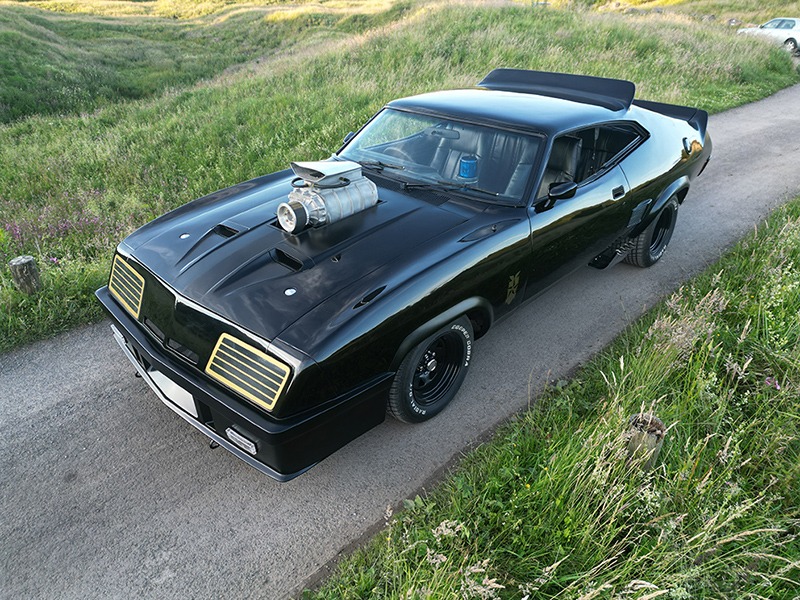
After a full year of toiling on the car during evenings and weekends, the day finally came: the build was complete. It was time to fire up the engine and take it out on the road. Not the wide-open highways of the Australian Outback, but rather the windy country lanes of Mark’s tranquil village. “I was nervous going up the road for the first time,” he admits. “But it proved to be a nice little cruiser.”
Understandably, after all the time and money spent on the restoration, Mark doesn’t risk taking the car out for lengthy road trips (or short hops to the supermarket for that matter). “It’s just a toy that comes out sometimes when the weather is nice,” he says. “I also take it to a few local car shows and car meets, where it sort of steals the show!”
As well as wowing fans at car shows, Mark’s vehicle was also the basis for Hachette’s 1:8 scale die-cast model of the Ford Falcon – a project that allows auto enthusiasts to replicate his build-up process without having to scour the world for parts.
One inevitable question remains: does Mark have plans to embark on a similarly arduous project in the near future? “No,” he laughs. “It was an exciting challenge, but I don’t think I could do it again!”
From its racing success to its enduring place in automotive history, the Ford Falcon remains one of the most iconic performance cars ever produced. For fans looking to celebrate this legendary vehicle, visit our online shop for available magazine issues and extras. Whether you're catching up on past releases or searching for unique collector's items, it's a great way to own a piece of Ford Falcon history and enjoy the story behind this motoring legend.