
The History of the Batmobile: From Batman's First Car to Modern Movie Icons
Published the 11Th may 2026
VEHICLES
DOES IT COME IN RED...?
By Nick Jones
Roaring through the crime-ridden streets of Gotham City, the Batmobile lives in the popular imagination as a sleek, black shadow, the stuff of nightmares given physical form. Yet the Batmobile has taken many shapes during its near-90-year history – even, in its earliest appearance, that of a striking red sedan…
BATMOBILE BY NAME
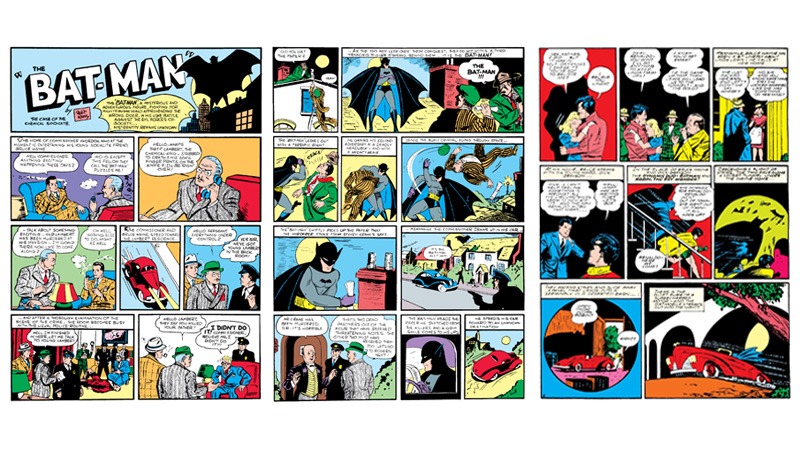
When Batman/Bruce Wayne made his debut in Detective Comics #27 in May 1939, as delineated by Bob Kane and Bill Finger, the Dark Knight Detective boasted few of the gadgets and equipment that would come to characterise him. One thing he did have from the get-go, however, was a car. Three pages into his inaugural adventure, ‘The Case of the Chemical Syndicate’, Batman got behind the wheel of a vibrant red automobile in pursuit of a murderer. The following issue, Batman again made use of his scarlet sedan, and would continue to drive what was termed in Detective Comics #39 (August 1939) “his special built high-powered auto” for the next few years. But while the Dark Knight’s bat-themed paraphernalia began to accrue over the course of these early outings, from the Batarang to the helicopter-like Batgyro, his red vehicle remained resolutely unnamed.
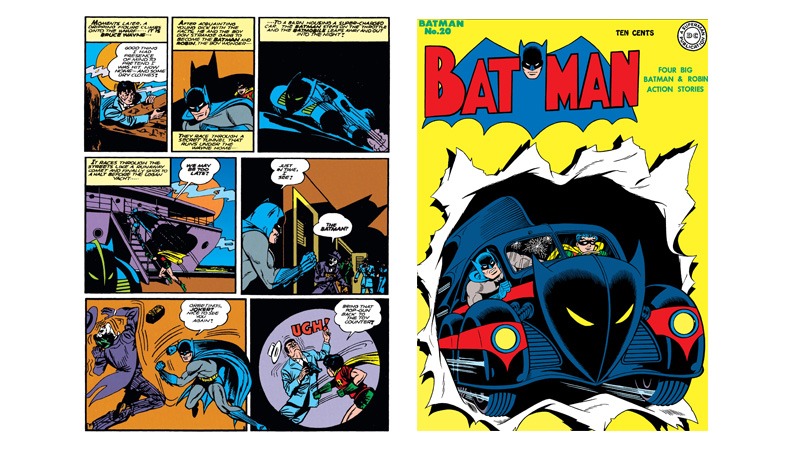
Then, in Detective Comics #48 (February 1941), the story ‘The Secret Cavern’ found Batman and his new young partner, Robin (alias Dick Grayson, who had been introduced the year before in Detective Comics #38), utilising a red roadster with a small bat ornament on the hood, accompanied by the caption, “There is the quiet purr of a supercharged motor – and the Batmobile streaks out into the night!” A few months later, in the Joker story ‘The Riddle of the Missing Card!’ in Batman #5 (Spring 1941), the Batmobile took on a darker countenance: a blue-and-black hardtop with a much bigger bat hood ornament and a batwing fin on the back. While halfway through the story the vehicle hurtled off a cliff and crashed into a ravine, later that same issue it was back in action. The Batmobile was here to stay.
CAR OF THE FUTURE
Which isn’t to say there weren’t more developments in store for Batman’s primary mode of transport. By the turn of the decade, the Dark Knight had switched to a more elaborate Batmobile, unveiling it in ‘The Batmobile of 1950!’ in Detective Comics #156 (February 1950) after the Batmobile he had been driving for the previous ten years plunged off a bridge over the Gotham River. Putting his long-gestating plans for a new vehicle into action, Batman built “a car that is years ahead of all other on wheels” – a “crime-fighting car of the future”, complete with a built-in crime lab, rocket tubes in the fenders and radar antennae in the tail fin.Versions of the revamped Batmobile remained in service through the 1950s and into the 1960s, with some modifications: first the tail fin grew, then the canopy took on more of a bubble-like shape, as different artists offered different interpretations of the car’s appearance.
A more comprehensive overhaul came towards the middle of the 1960s, when in ‘Two-Way Gem Caper!’ in Batman #164 (June 1964), Bruce Wayne literally pulled back a curtain to reveal a sleek new roadster to an astonished Dick Grayson. “The original Batmobile has had its day!” Bruce declared. “The trend now is toward sports cars – small, manoeuvrable jobs!” (That same story also revealed a new tunnel route out of the Batcave leading to a rocky hillside instead of a barn, and perhaps an even more starling innovation: an elevator down to the Batcave instead of stairs!)Just two years later, however, another Batmobile, one destined to make a much bigger impact, made its debut – and this time it wasn’t in a comic book.
TURBINES TO SPEED
In January 1966, the Batman TV show began airing in the US, and with it came an unforgettable new Batmobile. Based on Ford concept car the Lincoln Futura, the television Batmobile boasted twin bubble canopies, a flashing red beacon, long tail fins and a flaming exhaust, activated in the first episode by Bruce Ward’s Robin, sitting alongside Adam West’s Batman, with the immortal words, “Atomic batteries to power! Turbines to speed!” There had been screen Batmobiles before – a 1939 Cadillac in the 1943 Batman serial; a 1949 Mercury Convertible in the Batman and Robin serial six years later – but the gadget-filled 1966 iteration struck a chord, setting a precedent for the vehicle as a focal point both for audiences – who snapped up toy replicas of the car – and filmmakers.
The success of the Batman TV show was reflected in the comics, where by the end of the year the Batmobile’s windshield had taken on a double-bubble appearance (first glimpsed in December 1966’s Detective Comics #358) similar to that of the small-screen car. It wouldn’t be until more than a year later that the TV Batmobile would undergo a more complete conversion to comics form, however. In Detective Comics #371 (January 1968), the story ‘Batgirl’s Costume Cut-Ups!’ found Batman and Robin taking turns behind the wheel of a Batmobile that bore a striking resemblance to the television incarnation.
Versions of this vehicle continued to appear in comics over the remainder of the year, but by March 1968 the Batman TV series had come to an end. The result in comics was a succession of variations on a theme, some memorable – the coupé designed by artist Neal Adams in 1970, for instance – others less so. More enduring was the vehicle driven by Batman when he retuned to television screens in 1973, this time in animated form.
FAST FRIENDS
Based on the comic book concept of the Justice League of America, which since 1961 had united DC’s premier superheroes in one team, Super Friends started airing in the US in September 1973. The main line-up comprised Superman, Wonder Woman, Aquaman, Batman and Robin, the latter two of whom brought with them a Batmobile that streamlined and simplified the 1966 Batman automobile and introduced oval yellow bat-emblems on the doors, a feature that became a staple in comics for the next ten years or so. But it was the Batmobile introduced in 1978 follow-up series Challenge of the Superfriends that arguably made more of a mark. A sloped-nosed roadster with lights on the bonnet that echoed the eyes in Batman’s cowl, the car gave rise to a raft of toys and influenced depictions of the Batmobile in comics through the end of the 1970s and well into the 1980s.
While in Batman #344 (February 1982), writer Doug Moench and artist Gene Colan introduced the innovation of Bruce Wayne’s Rolls Royce transforming into the roadster, and in Batman #385 (July 1985), artist Rick Hoberg added the rear twin canopies seen on the 1984 Kenner Super Powers Batmobile toy, it wasn’t until 1986 that a truly radical new take on the car came along in comics. In the second issue of Frank Miller’s future dystopia Batman: The Dark Knight Returns (June–December 1986), Batman drove a hulking tank of a Batmobile into battle against a gang of Gotham City Mutants. Two years later, Jim Starlin and Bernie Wrightson’s Batman: The Cult (September–Winter 1988) presented a similar modern-day spin, as Batman and Robin (alias Jason Todd, the second Robin, whose revised origin the previous year had seen him stealing the tyres off the Batmobile) piloted a monster-truck Batmobile in a pile-driver assault on underworld insurgents.These outsize examples of the Batmobile would find their ultimate expression two decades later in the trilogy of Batman films directed by Christopher Nolan, but more immediately, another director would offer his own highly stylised vision of the vehicle.
BATMOBILE FOREVER
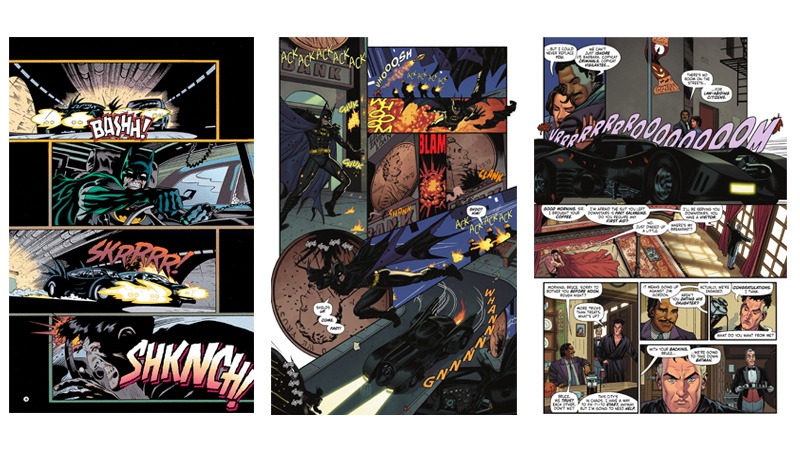
The buzz surrounding the big-screen Batman had reached fever pitch long before the film was released in June 1989. The securing of Beetlejuice’s Tim Burton as director and casting of Michael Keaton as Bruce Wayne/Batman and Jack Nicholson as the Joker were major factors in the mounting excitement, but just as important was the gothic feel of the film, as established by The Company of Wolves (1984) production designer Anton Furst and his team, and especially the Batmobile, designed by draughtsman Julian Caldow under Furst’s direction. One of Caldow’s early iterations envisaged the vehicle as a kind of land-speed car, with twin cockpits, akin to those of the 1966 Batmobile, separated by a central rocket tube. When the need for Batman and Vicki Vale (Kim Basinger) to be able to speak to one another put paid to that idea, Caldow drew inspiration for his redesign from the Corvette Stingray, the Ferrari Testarossa and onetime land-speed record holder the Green Monster, with the final design incorporated shielding inspired by Raymond Loewy’s Art Deco locomotives and a cockpit that slid down from the hood (suggested by concept artist Nigel Phelps after Caldow neglected to include doors; the design also necessitated Keaton wearing a short-eared version of Batman’s cowl, as there wasn’t room in the cockpit for the full cowl).
The 1989 Batmobile was back for Burton’s 1992 sequel Batman Returns, and would prove hugely influential over ensuing decades in comics, animation, video games (notably 2009’s Batman: Arkham Asylum) and other media. For 1995’s Batman Forever, however, new director Joel Schumacher and Bruce Wayne/Batman star Val Kilmer brought with them a reworked Batmobile, this time overseen by Schumacher’s Falling Down (1993) production designer Barbara Ling. Featuring organic-looking ribbing, the car was again reworked by Ling for Schumacher’s 1997 George Clooney-starring follow-up Batman & Robin, the designer taking inspiration from roadsters like the 1938 Delahaye 165 Cabriolet and 1954 Jaguar D-Type in an effort to conjure a car with more screen presence. In the meantime, Batman: The Animated Series proffered another striking take on the Batmobile when the ground-breaking show debuted in 1992, merging elements of the Batmobile from the Burton movies with cars from the comics.
Certainly there was no shortage of comic book takes on the Batmobile through the 1990s, with the muscular version unveiled by artist J. H. Williams III in Batman #526 (January 1996) proving particularly enduring. But the 1960s TV show and 1980s/1990s movies had made the car a star in a way comics never had, fixing the vehicle in the collective consciousness as central to the Batman mythos. And as the 2000s got underway, a fresh filmmaking talent would make the car the focus of his utilitarian take on Batman too.
BEGIN AGAIN
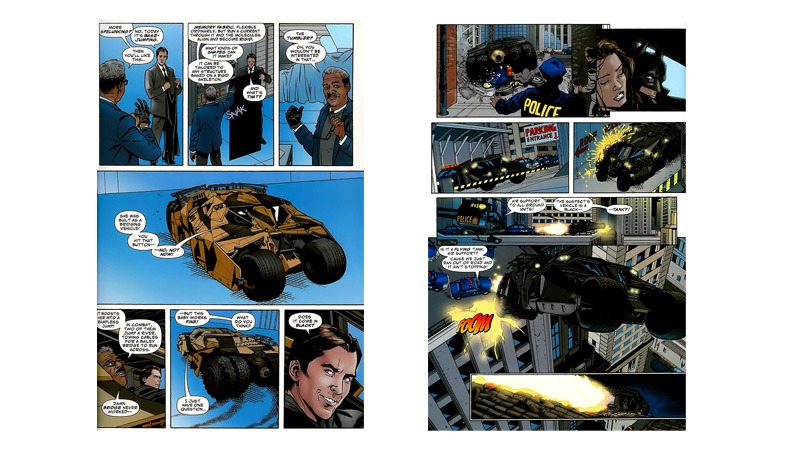
When Memento (2000) and Insomnia (2002) director Christopher Nolan was first exploring the notion of a Batman movie based not on the heightened gothic fantasy of the Tim Burton films, but a more realistic action-movie aesthetic, he asked the studio what their requirements might be. Among the elements suggested was that it would be good to have a cool car. At first Nolan was sceptical he could make that work within the more realistic milieu he envisaged, but as he and Blade scribe David S. Goyer wrote the script for what would become Batman Begins (2005), the Batmobile became the focal point of their functional vision. Working out how something so implausible as the Batmobile could have a basis in the real world turned out to be the key to unlocking how such an outlandish figure as Batman might actually exist.In the story that Nolan and Goyer crafted, the Batmobile was originally the Tumbler, a prototype developed by Wayne Enterprises’ Applied Sciences Division as a bridging vehicle for the military – an armoured tank with the ability to boost over rivers.
As the pair wrote, Nolan shaped a ball of clay to show Goyer the kind of car he meant: a low, sloping vehicle with the weight of a tank – a cross between a Lamborghini Countach and a Hummer. With its angular panels and immense bulk, the final automobile, as realised by Nolan’s Insomnia production designer Nathan Crowley, bore a remarkable resemblance to Nolan’s clay maquette, but also recalled the hulking Batmobile from Frank Miller’s The Dark Knight Returns. So impressed were the studio executives when they saw Crowley’s kit-bashed model that they financed a full-size prototype (and multiple working cars over the course of production), while in the finished film, an equally impressed Bruce Wayne/Batman (Christian Bale) enquired of Wayne Enterprises’ Lucius Fox (Morgan Freeman) after test-driving the camouflage-painted Tumbler, “Does it come in black?”
Nolan and co.’s 2008 sequel to Batman Begins, The Dark Knight, added the innovation of a motorcycle-like Bat-Pod breaking out of the wrecked Tumbler during a pursuit of Heath Ledger’s Joker, while 2012’s The Dark Knight Rises introduced the Bat, a slightly more fantastical vertical take-off-and-landing craft. But it wouldn’t be until 2016 that the next big-screen Batmobile would make its debut, this time under the aegis of a director establishing a new era of DC filmmaking.
JUSTICE V VENGEANCE
In 2013, Watchmen director Zack Snyder presented a science-fictional take on Superman, bringing some of the realism of the Dark Knight Trilogy to his Man of Steel, with Henry Cavill as the eponymous lead and David S. Goyer and Christopher Nolan on board as writers. Three years later, Snyder turned his brand of stylised realism, as his producer wife Deborah Snyder termed it, to sequel Batman v Superman: Dawn of Justice (2016), as DC’s shared cinematic universe took shape. Introducing Ben Affleck’s brutal, battle-worn Bruce Wayne/Batman, the film called for a fresh approach to the Dark Knight and his world, a task which fell to 300: Rise of an Empire (2014) production designer Patrick Tatopoulos.
Much as on Batman Begins Nathan Crowley had first worked on the Tumbler, Tatopoulos’s first act was to sketch a Batmobile design on a coffee-shop napkin. The production designer’s personal passion for motorbikes could be seen in the car’s low-slung side profile, with the finished design a heavily armed cross between an off-road racer and a Formula 1 car.Even more stripped back was the Batmobile driven by Robert Pattinson’s Bruce Wayne/Batman in 2022’s The Batman, Dawn of the Planet of the Apes (2014) director Matt Reeves’ revisionist, psychological story of Batman’s second year of operation. In keeping with the self-made, DIY aesthetic of this particular Dark Knight, Reeves, his Dawn of the Planet of the Apes production designer James Chinlund and their team wanted to convey a powerful car that had been welded together by Bruce Wayne from other vehicles, a case of form following function in the shape of a jerry-rigged, turbo-charged muscle car.
With its flaming front grille, the final result was an intimidating, feral beast, intended to instil fear in anyone who gazed upon it. Inspired in part by John Carpenter’s 1983 movie version of Stephen King’s Christine, it may not have been painted red like King’s possessed Plymouth Fury, or indeed the very first Batmobile, but as it fired into thunderous to life with a deafening roar, this Batmobile was every inch the stuff of nightmares.
Nick Jones is the author/co-author of DC Cinematic Universe, The DC Comics Encyclopaedia, DC Comics Cover Art, Guardians of the Galaxy: The Ultimate Guide and Marvel Arms and Armour.
From Gotham City's dark streets to the silver screen, the Batmobile has become one of the most iconic vehicles in popular culture. For fans looking to celebrate the Caped Crusader's legendary ride, magazine issues and extras are available from our online shop. Whether you're expanding your collection or exploring the rich history behind Batman's famous vehicle, it's a fantastic way to own a piece of superhero history and bring the world of Gotham closer to home.